

Why I Design Collections Instead of Single Patterns
I’ve had a Mickey Mouse kitchen for nearly 35 years.
Yes, really.
It may not be what you’d expect from someone who designs coastal wallpaper and fabric, but I’ve loved Disney for as long as I can remember. Over the years I’ve collected pieces that make me smile, and somehow they’ve all found their place in my kitchen. That kitchen has taught me something I didn’t fully appreciate until I became a surface pattern designer.
People don’t decorate their homes by randomly choosing things they like. They usually begin by falling in love with something. It might be a wallpaper, a favorite color, a family heirloom, or even Mickey Mouse. Once they’ve found that one thing, the next challenge is figuring out what goes with it. That’s where decorating can start to feel overwhelming. There are thousands of fabrics, wallpapers, pillows, and home accents to choose from. Sometimes having endless options doesn’t make decorating easier. It makes it harder.
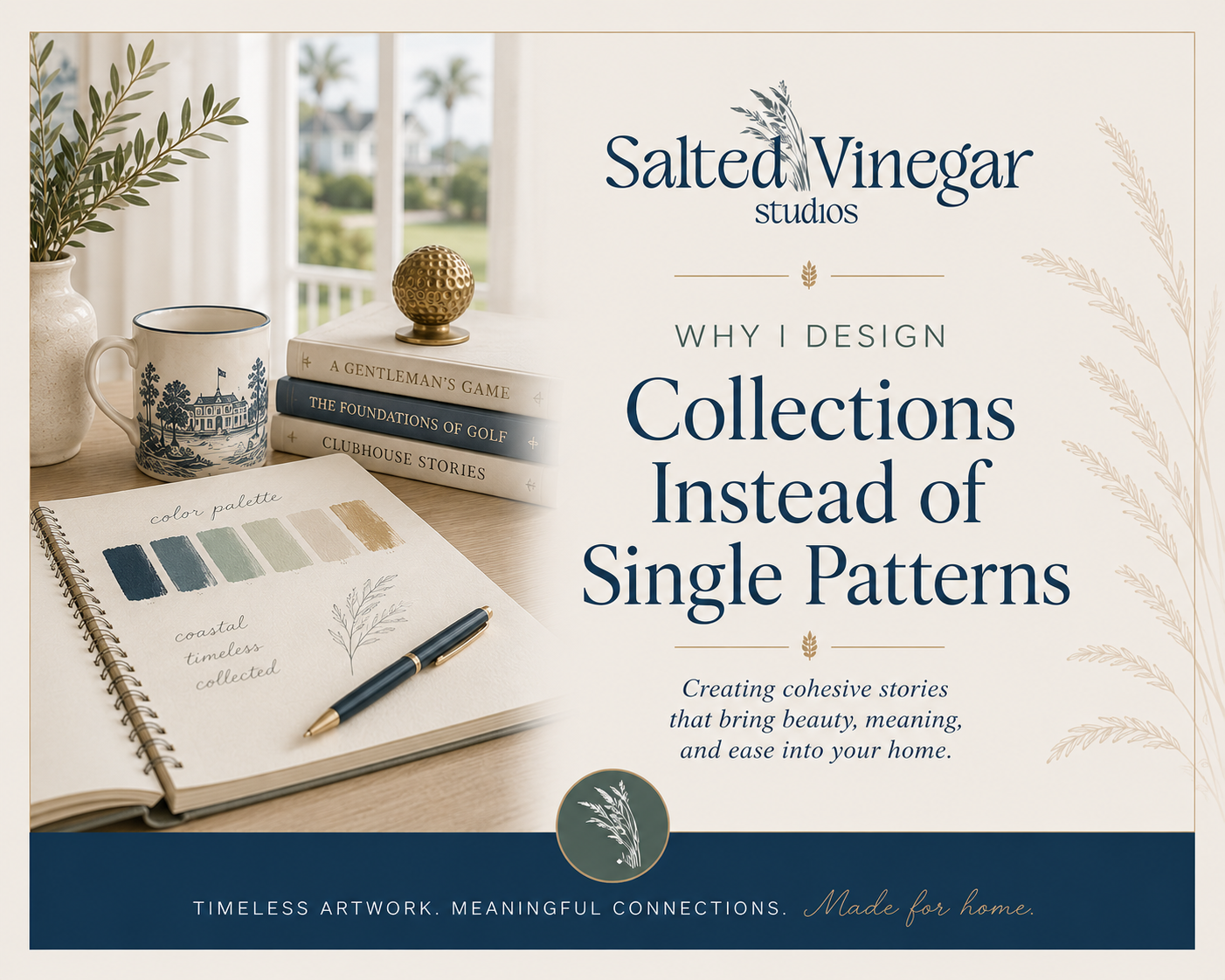
That’s one of the biggest reasons I design collections instead of single patterns. I don’t create collections to give you more choices. I create them to give you fewer. Every collection I design begins long before I sketch a flower, a golf club, or a citrus slice. It begins with color.
I spend a surprising amount of time developing a color palette before I ever start drawing. I compare shades, move colors around, and make tiny adjustments until everything feels balanced. Does that palette change as I design? Absolutely. It almost always evolves a little. But having that foundation gives every pattern a common thread.
One of the most valuable lessons I learned early in my design journey came from participating in a series of designer challenges. Every artist was given the exact same theme and the exact same color palette. Our job was to create an entire collection using only those colors. At first, working with a limited palette felt restrictive. Instead, it became one of the best lessons I could have learned.
I realized that when colors work together instead of competing with one another, everything feels more intentional. That idea has stayed with me ever since, not only in my artwork but in the way I think about decorating a home.
Once my color palette is established, I begin sketching. Sometimes I start with what eventually becomes the hero print. Other times I don’t. I know that might surprise people, but some of my favorite designs begin as simple doodles while I’m relaxing in the evening.
As the hero pattern develops, I start looking at all of the individual pieces inside it. A single leaf might become a coordinate. A texture might become a blender. A simple line might inspire a stripe. Instead of creating brand-new artwork every time, I’m allowing one idea to grow into several designs that naturally belong together.
Each pattern has a different role. The hero gets to be the star. The coordinates support it. The blenders create moments of quiet. The stripes help connect everything together without demanding attention. That’s important because I don’t want every pattern competing for attention. I want them working together.
When I think about someone using one of my collections, I’m not picturing them buying a yard of fabric. I’m picturing someone standing in a bedroom they’ve been decorating for weeks. Maybe the hero pattern becomes the duvet cover or the wallpaper. The coordinate becomes the sheets. A blender finds its way onto a throw pillow, and a stripe appears on an accent chair. Instead of wondering if those pieces work together, that decision has already been made. I’ve already spent the time making sure the colors flow, the scales complement one another, and no pattern overwhelms the others. That means you can spend less time second-guessing your choices and more time enjoying the process of creating a home that feels like yours.
One of my favorite parts of designing a collection comes after I think I’m finished. That’s when I begin creating mockups. Seeing the patterns inside an actual room tells me things I can’t always see while I’m designing. Sometimes everything works exactly as I hoped. Other times the room tells me something is missing.
That happened recently with my Clubhouse Collection. I thought the collection was complete. Then I started placing the designs into mockups and realized every pattern was asking for attention. I needed something quieter. So I went back to the artwork, pulled one simple element from several of the designs, and created a clean grid pattern that tied the entire collection together.
Other times I’ll remove a design completely because it doesn’t belong. That doesn’t mean it failed. I keep a growing library of coordinates, blenders, textures, and sketches because I never know when one of them will become the missing piece of a future collection. Nothing is ever wasted.
I’ve also noticed something about my own collections over the years. Navy blue seems to find its way into many of them. Sometimes it’s obvious. Other times it’s only in the line work. I don’t do that on purpose, at least not at first. But I think it reflects how I decorate my own home. I don’t believe every room should look the same. I do believe it’s comforting when there’s a small thread connecting them.
I remember my aunt, who owned a beautiful bath and bedding store in Florida, decorating her own home that way. Every room had its own personality, yet a touch of deep green quietly appeared throughout the house. Looking back, I think that’s one of the reasons her home always felt so peaceful.
Maybe that’s why I keep coming back to navy.
At the end of the day, my goal isn’t simply to design pretty patterns. It’s to create collections that help tell your story in a thoughtful, elevated way. I hope they make decorating feel a little less overwhelming. I hope they help create spaces where you enjoy your morning coffee, curl up with a good book, gather with family, or end a long day feeling completely at home. Because when a room feels calm, cohesive, and personal, it isn’t just beautifully decorated.
It feels like it belongs to you.